The Short Answer: For an FHA manual underwrite, acceptable compensating factors include verified cash reserves (3 – 6 months of payments), a minimal housing payment increase (under $100 or 5%), documented residual income meeting VA benchmarks, significant extra uncounted income, or a lack of discretionary debt.

These factors allow lenders to approve total debt-to-income (DTI) ratios up to 50%.
A little more background on this subject:
- Manual underwriting happens when automated approval fails and requires a human review of your full financial profile.
- FHA sets strict DTI limits, and you must fall within them to qualify unless you have compensating factors.
- Compensating factors are documented financial strengths that allow lenders to approve higher debt ratios.
- Higher DTI ratios require one or more approved compensating factors, depending on the scenario.
- FHA recognizes five main factors: cash reserves, minimal payment increase, extra income, residual income, and little to no discretionary debt.
Automated vs. Manual Underwriting Explained
When you apply for an FHA mortgage, your application will probably pass through an automated computer system that evaluates your credit, income, and debt to issue an initial approval.
But if that automated system cannot give you an instant “yes”—or if your credit profile has unique red flags like a past bankruptcy, foreclosures, or a low credit score—your loan must go through manual underwriting.
In manual underwriting, a human underwriter will personally review your entire financial package to decide if you qualify for an FHA loan. And in these scenarios, the FHA sets strict limits on how high your debt payments can be relative to your income.
But the FHA allows lenders to “stretch” those debt limits a bit more if you have certain financial strengths to balance the risk. In the mortgage industry, these official financial strengths are called compensating factors.
Below, we break down when manual underwriting happens, how debt limits work, and the exact compensating factors FHA allows.
Understanding the Math: Debt-to-Income (DTI) Ratios
Before diving into compensating factors, it helps to understand how lenders measure your debt. Lenders use two numbers, collectively called your Debt-to-Income (DTI) ratio, written as two percentages separated by a slash (for example: 31/43):
- The Front-End Ratio (Housing Ratio): The percentage of your gross (before-tax) monthly income that goes toward your new house payment (including principal, interest, taxes, home insurance, and FHA mortgage insurance).
- The Back-End Ratio (Total DTI): The percentage of your gross monthly income that goes toward your new house payment plus all your other recurring monthly debts (car payments, student loans, credit card minimums, child support, etc.).
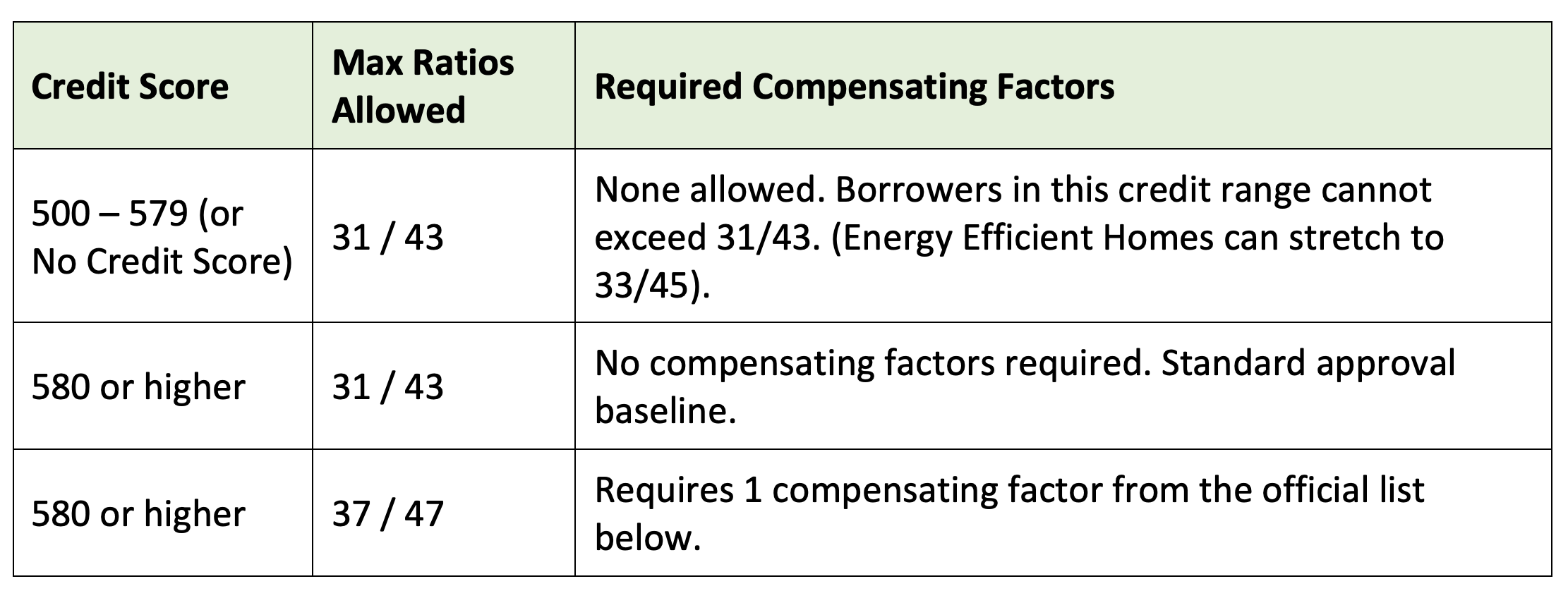
For standard manual underwriting, FHA sets a benchmark cap of 31/43. That means no more than 31% of your income should go toward housing, and no more than 43% should go toward your total debts combined.
To go higher than those standard limits, you must show official compensating factors.
The FHA Manual Underwriting Benchmark Matrix
Debt ratios that exceed the 31/43 limit mentioned above usually require compensating factors. And the higher the ratio, the more compensating factors you must provide.
The following table was adapted from the HUD handbook for FHA loans:
The Full List of FHA Compensating Factors
HUD Handbook 4000.1 lists and describes the specific compensating factors a lender can use to justify higher ratios on a manually underwritten loan:
1. Verified Cash Reserves
Having emergency savings left in your bank account after you pay your down payment and closing costs proves you won’t be living paycheck-to-paycheck.
- The Rule: You must have enough documented cash remaining to cover at least 3 full monthly mortgage payments for a 1- to 2-unit home, or 6 full monthly payments for a 3- to 4-unit home.
- What Doesn’t Count: Gift funds, money borrowed from someone else, or cash back from the transaction typically cannot be counted as reserves.
2. Minimal Increase in Housing Payment
If your new mortgage payment is nearly the same as what you’ve successfully paid in rent or mortgage payments for the last year, you’ve already proven you can manage the expense.
- The Rule: Your new total monthly house payment cannot exceed your current rent or mortgage payment by more than $100 or 5% (whichever is less).
- Documentation Required: You must document a full 12-month consecutive payment history showing no more than one 30-day late payment. If you currently live rent-free, you cannot use this compensating factor.
3. Significant Additional Income (Not Counted in Main Income)
You may earn money from overtime, bonuses, part-time work, or seasonal jobs that couldn’t be included in your primary qualifying income (for instance, because you haven’t been doing it for a full two years yet).
- The Rule: The lender must verify you have received this extra income for at least 1 full year, and it must be likely to continue.
- The Impact: If adding this extra income into your calculations would theoretically bring your debt ratios back down to 37/47 or lower, it can be cited as a factor.
4. Residual Income
Residual income is the amount of money a borrower has left over each month after paying all recurring monthly debts, including the mortgage payment. This remaining income is used to cover everyday living expenses like food, clothing, transportation, utilities, etc.
- The Rule: The lender calculates your leftover monthly cash using your family size and location, comparing it against the U.S. Department of Veterans Affairs (VA) Residual Income tables. If your remaining cash meets or exceeds the VA benchmark for your region and household size, it counts as a factor.
(And yes, the FHA does use the VA’s income tables for this requirement.)
5. No Discretionary Debt
This factor is designed for borrowers who have little or no recurring consumer debt and do not carry balances on revolving credit accounts.
- The Rule: Your new mortgage payment must be the only open account with an outstanding balance that is not paid off in full every month.
- Requirements: You must have established credit lines in your name that have been open for at least 6 months, and you must document that these accounts have been paid off in full every month for at least the past 6 months. Authorized-user accounts do not qualify.
- What Doesn’t Count: If you have no established credit lines in your own name, or if you carry balances on credit cards, personal loans, or other consumer accounts from month to month, you do not qualify for this compensating factor.
Summary: A Checklist for Manual Underwriting Success
If your FHA home loan requires a manual underwrite, and your debt ratios exceed 31/43, consider the following options:
- Pull Together Extra Savings: Leaving at least 3 months of mortgage payments untouched in the bank after closing is often the easiest compensating factor to satisfy.
- Document Your Rent History: Keep clear, verifiable receipts or canceled checks showing 12 months of on-time rental payments to prove a minimal payment increase.
- Keep Consumer Debt Low: Paying off credit cards and avoiding new auto loans before applying keeps your DTI lower and opens up special ratio options like 40/40.
Disclaimer: This guide is for general informational purposes only and does not constitute financial or lending advice. FHA guidelines and lender requirements can vary by situation and may change over time. For official and up-to-date guidance, refer to HUD Handbook 4000.1 or contact the FHA Resource Center, and consult a qualified mortgage professional regarding your specific circumstances.